How the ATLAS Bot Reads an Opponent Deck
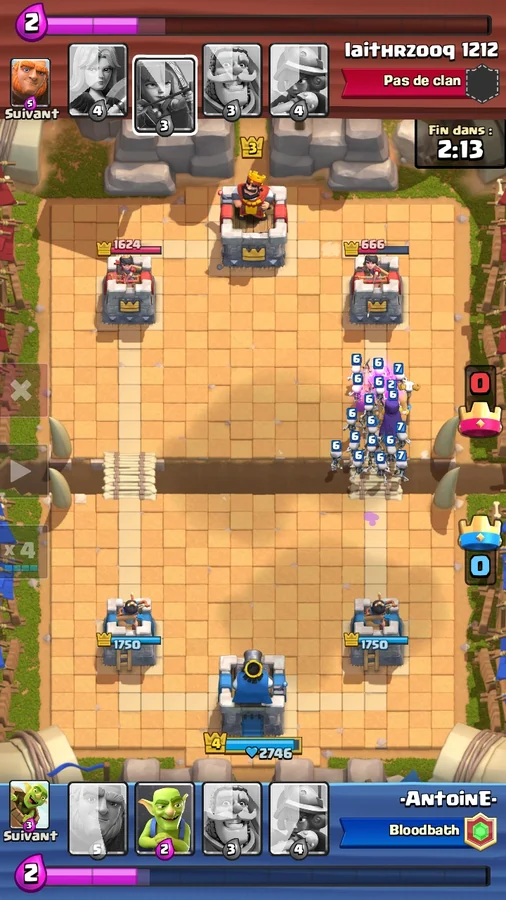
A Clash Royale match starts with almost no information. Your opponent has eight cards and you can see none of them. By the end of a long match you can see all eight, because the only way to use a card is to play it, and playing it puts it on the arena where anyone watching can read it.
That is the whole mechanism. The deck is not hidden, it is revealed on a schedule set by the opponent. What a bot can do is keep track properly, which is the part humans are worst at under time pressure.
Eight cards, one at a time
The first time a card appears, it joins the list. Second Hog Rider of the match tells you nothing new. The first Valkyrie tells you one of their eight slots, and it also tells you something about the other seven, because decks are built as decks. Somebody who opens with a Hog Rider and a cheap spell is probably on a cycle deck, and the heavy tank you were worried about is probably not in there.
So the reading starts vague and sharpens with every new card. Early in a match the bot is working with two or three known cards and a rough idea of the shape. By the second minute it usually has most of the deck, and from then on it knows what can answer what it is about to send.
Counting elixir
Elixir is public too, in the sense that spending it is visible. Both players fill at the same rate, both start at the same point, and every card played costs a known amount. Subtract what they spend, add what the clock gives them, and you have a running estimate of what they can afford right now.
It is an estimate rather than a readout. The bar on their side of the screen is not shown to you, so the count drifts if a card is played at the edge of the arena and missed for a moment, and double elixir resets everyone's intuition. The useful version of the number is coarse: can they afford a response to this, or are they a second or two short.
Cycle, which is the real payoff
A Clash Royale hand is four cards drawn from eight, and a played card goes to the back of the queue. So once the bot knows the deck, it knows roughly where each card sits in the queue. If their only answer to a Hog Rider went down twenty seconds ago, that answer is not available yet, and that is the moment the Hog goes over the bridge.
Knowing the deck, the elixir and the cycle at the same time is what turns a card list into a decision. Two of the three is not much. All three is the thing a strong player does instinctively and loses track of when the match gets busy.
What it does with that
- Hold a counter instead of spending it. If their win condition is known and their elixir says it is coming, the card that answers it stays in hand rather than getting thrown at a chip push.
- Push the lane they cannot cover. If the defence that handles your tank is somewhere behind in their queue, the tank goes now.
- Commit when the answer is out of cycle. The best moment to attack is the window where the card that beats your push has just been used.
- Refuse a trade. Spending four elixir to kill a two elixir card is losing slowly, and a count makes that visible rather than something you feel afterwards.
- Defend first in double elixir. When both sides can afford everything, the reading matters less and the ordinary advice of defending and countering matters more.
None of this is exotic. It is the same thinking that a counter cheat sheet encodes, applied continuously instead of from memory.
Where it goes wrong
Mirror matches. Both players on the same deck means both sides know everything, and the reading advantage disappears. What is left is placement and timing, which is a different problem, and the bot is no better off than its opponent there.
A card it has not seen yet. Early in a match most of the deck is unknown, and a deck that holds its answer until the first real push looks, for a while, like a deck without one. Commit on that reading and you lose a tower to the card that was there the whole time.
A swap mid-ladder. Decks change between matches. The read is built fresh each battle for exactly that reason, and anything carried over from the last one is a liability. A player who switches cards between games is reliably harder to read than one who grinds the same list.
Spells and buildings muddy the count. A spell cast off screen edge, a building placed in the fog of a busy arena, a card played the instant the clock changes. Each one is a small drift in the elixir estimate, and drifts add up over three minutes.
What it does not know
It does not know their hand. The deck is learnable because cards get played; the four cards sitting in their hand right now are not visible on the screen, so the bot works with a probability over the queue rather than a certainty. It does not know what they are about to do, and it has no information about the account on the other side.
And it is reading one arena at a time with seconds to spend, which is the hard constraint behind all of this. A decision that arrives two seconds late in Clash Royale is a decision that did not happen. Botting Clash of Clans against Clash Royale is mostly about that difference.
The honest summary
Deck reading is bookkeeping done faster than a person can do it while also playing. It helps most in the middle of a long match against a familiar archetype, and least in the first thirty seconds, in a mirror, and against someone who changes their deck. The Clash Royale bot plays Trophy Road, Ranked and 2v2 with it, and you set the losing streak at which it stops for the day.
Worth saying plainly, since this is a post about what the bot can work out: botting breaks Supercell's terms of service and an account can be banned. Use it on an account you are prepared to lose.
Watch it track a deck
Trophy Road, Ranked and 2v2, with Hog cycle, Golem beatdown, Log bait or your own list. Start with the free trial and watch what it holds back.
Get Started